
How d you accelerate change in the Thanksgiving season, this season of family gatherings?
I’m often surprised at what business psychologists know that family leaders could benefit from knowing and practicing… here’s my favorite example.
As we approach the season of family gatherings, you may want to share this post with your loved ones!
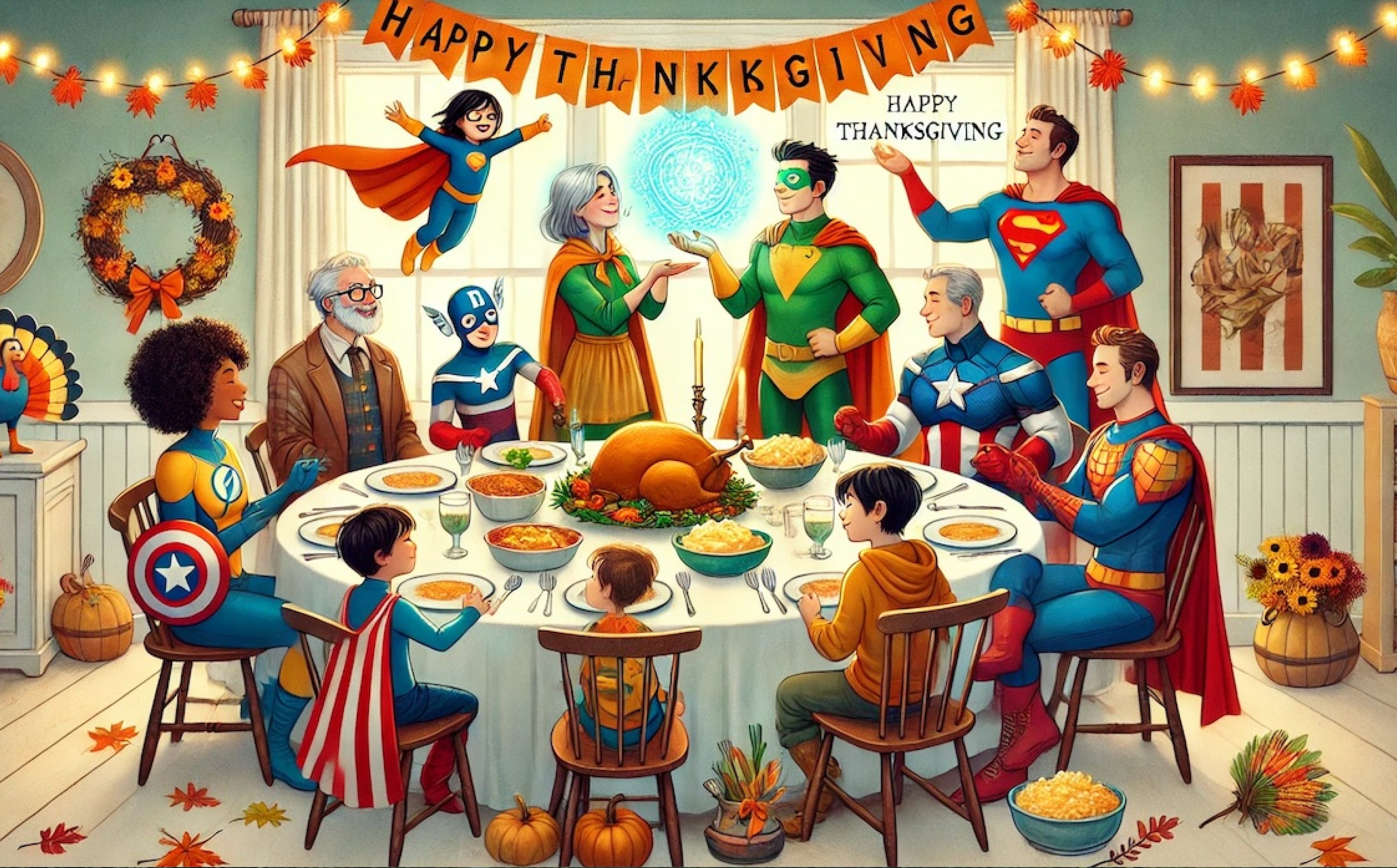
All family leaders struggle with organizational change. How could our relationships be anything else? Families are complex. Family enterprises are infinitely complex. No one likes to be told to change. We all want to accelerate change, but many people don’t know how to do so.
We all bring our biases and adopt heuristics to reduce that complexity. Attorneys say, “We mitigate risk.” Wealth advisors say, “We leverage capital assets.” Next Gens say, “We want to innovate.”
This post answers that ancient question, “How can family leaders accelerate change?
Answer: Practice PsyCap
Deliberate practice leads to change, for any athlete or business leader. What would happen if we practiced a more pervasive and universal view of capital?
We all use heuristics (patterns for what works) to reinforce the structures that reflect our worldview or experience. One common example is the multidisciplinary views of capital, that includes financial, social, human, family, legacy, and intellectual views of capital.
Business psychologists (like me) know that Psychological Capital (PsyCap) is a dynamic, validated construct that can be used to describe any individual or family enterprise. PsyCap is defined as a construct based on 4 inter-related competencies: Hope, Efficacy, Resilience, and Optimism (Luthans, F., Youssef—Morgan, C.M. & Avolio, B.J. (2007). Psychological Capital: Developing the Human Competitive Edge. Oxford, England; Oxford University Press).
As Fred Luthans states, “PsyCap has and continues to take off across the world … I have over 166,000 citations of my research which has been awarded in the top 1% of all researchers in all fields in the world and ranks #1 in organizational behavior textbooks. In other words, I am very happy with how PsyCap is going, especially in the global economy.” (direct communication 9.5.24)
The HERO model is more than a convenient acronym. The HERO-within model is a critical approach that leaders can apply at multiple levels- individual, team/ family, and organizational/ societal. I’ve practiced the HERO model with countless clients for decades. You can also do so.
Leaders, by definition, influence the behavior of followers toward a better future. They practice public optimism.
Practitioners, by definition, practice new behaviors and share them widely. My opinion is that practitioners have a fiduciary responsibility to practice both new ideas (innovation) and celebrate strengths (stability) every day.
The purpose of this article is to introduce the HERO model, like a new vocabulary term, and examples that can be applied by family leaders, and advisors in any discipline.
I invite you to assess how you can apply these practical examples with yourself, your family, and with the clients you serve.
Imagine that you are building a house with a garden that you hope will support generations of loved ones. Hope is defined as “the will and the way” to build a better future (Lopez, S.J. (2013) Making Hope Happen; Create the Future You Want for Yourself and Others. New York, New York: Simon & Schuster). Every founder believes “I can build this product or service.” Their hopes are often defined in founder’s history books or videos, vision statements, the stories told and re-told at gatherings.
Efficacy is the capacity to build that new house, to get the job done. We all use blueprints such as values statements, family constitutions, charters, phased strategic plans for new projects.
Resilience is our capacity to respond to adversity by returning to the same or a better level. Examples include our responses to global disease, market adversity, or loss of our loved ones.
Optimism is our choice to believe in a positive outcome, such as well-being for our children and grandchildren. All four of these competencies can be measured, taught in under 90 minutes, and developed over time. The PsyCap impact is more significant when all four competencies are measured (a second-order effect) than when only one or three competencies are measured. (Luthans, F., Youssef—Morgan, C.M. & Avolio, B.J. (2007). Psychological Capital: Developing the Human Competitive Edge. Oxford, England; Oxford University Press)
OK, so what?
The HERO Model applied at the Team/ Family level
Teams are defined as groups with a shared purpose, such as a family, board, executive leadership team or family council. Work teams often include more non-family than family leaders. PsyCap can be developed for any team!
Here are some good, better and best practices.
1. Define your family. Discuss it, write it and review it regularly. Your definition of family may be based on blood, shared beliefs, culture, religious norms, generations, or restricted to specific assets, like who can use the beach house. Then use the HERO vocabulary in your personal meetings and vacations and investments. Next Gen leaders may have a different expectation for “family” because societies always evolve.
2. Regular Meetings. Effective meetings have a cadence, and structure, designed to accelerate engagement. For many years I’ve used a “HERO Update” as a check-in or “Getting On Board” (GOB) activity. It’s on the agenda and I open the family meeting by asking, “Who has an example of someone else being a HERO?” When we recognize the desired behaviors of others, and lift those examples, we get applause or celebration. The result sets the tone for public validation, which is the most significant motivator for desired behaviors. Great meetings require that we focus on the successes of others. Family leaders need to manage that process.
3. Schedule The Talks. Elders sometimes avoid conflict because they don’t know how to talk with their loved ones about asset transfer or legacy. Communication skills can be developed, in small groups and in families. One reason for practitioners to team with other advisors with different skills (legal, wealth, behavioral psychology, etc.) is to manage the process and accelerate those talks. (Cite https://journals.sagepub.com/doi/abs/10.1177/0894486514538652 )
4. Share Legacy Conversations with your heirs or Elders about your values, mission statement, hopes or fears. Notice HOW they say whatever they say. Add to your legacy conversations any attitudes or behaviors you want developed. Remove from your legacy conversations any attitudes or behaviors you want eliminated. Take good notes, use a spreadsheet, record them on Zoom, and share your observations with others. Family gatherings during this holiday season is a perfect time for 1:1 walks. From Ghandi to Jesus to your grandfather, leaders have led change by walking and talking- called “twalking” and taught at Stanford’s Business school. Try it.
5. Love Letters. Write a private love letter to each of your heirs and elders. Use the HERO vocabulary to structure each letter. Share them annually at Christmas, Thanksgiving, anniversaries or birthdays. Yes, I’ve done this activity for decades and it leads to tears and statements like, “This is my favorite Christmas tradition.”
6. Celebrate PsyCap in others. The biggest motivator of human achievement is public recognition (not cash). We can measure the use of the words “hope, efficacy, resiliency and optimism” in AI meeting summaries, investor reports, and any meeting. Then we can create a trend report or PsyCap Index, just like an Edelman Trust Index or Human Capital Index (see the impact of ISO 30414). All Family Business leaders use these words. Few leaders measure their impact.
7. Practice New Rituals. Every religion, school and family has rituals to reinforce shared beliefs. When we practice prayers, mindfulness, gratitude and the HERO model, then we are more likely to experience those outcomes. One of my clients has a 6’ statue of The Bear, representing their founder. Each time he walks through the lobby he states “Hello Bear” out loud. They share successes in a newsletter called “Bear Tips.” What new rituals do you need to adopt or nurture?
Conclusion
Like every family leader, I’m regularly reminded of how little I know. Our children remind me! I ask for advice, and read, and on good days I listen well. Then I try something new. The PsyCap term may be new to some readers. However, the words “hope, efficacy, resilience and optimism” are ancient and familiar.
If we embrace the HERO model for our loved ones and our clients, then we are practicing ancient wisdom, in a new way. (cite Gray, D.W. (2018). Positive Psychology Coaching Protocols: Creating Competitive Advantage for Leader Development. Ann Arbor, MI: ProQuest).
My experience is that Psychological Capital describes changes for family leaders, and family-centric values over a longer term than any other measure of capital. Please contact me if you share that bias or want to continue this conversation.
Author bio:
Doug Gray, PhD, is the CEO of Action Learning Associates www.Action-Learning.com and a champion for Family Business leaders. His most recent book is The Success Playbook for Next Gen Family Business Leaders (2024). His projects include www.AssessNextGen.com and www.Family-WealthNetwork.com