
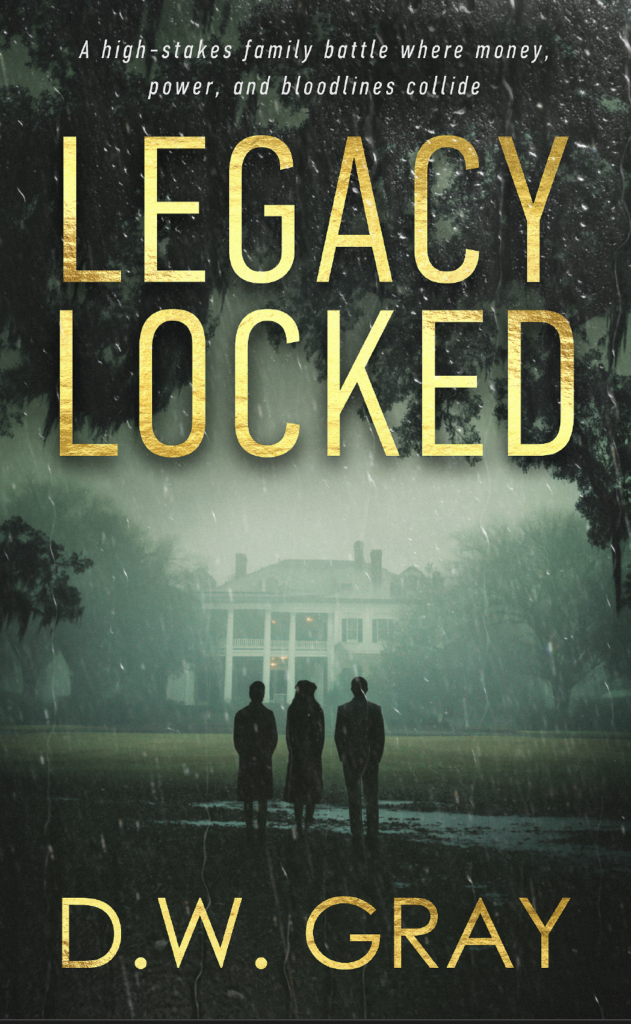
Sample excerpt from Legacy Locked
Copyright © 2025 by D.W. Gray, PhD. All rights reserved.
Thank you for purchasing an authorized copy of this book and for complying with international copyright law. No part of this book may be reproduced or used in any manner without the prior written consent of the copyright owner, except for the use of brief quotations in a book review.
The information contained in this fictional book is not intended as a substitute for expert services or consultation with any financial, legal, or business consultants. All readers have unique circumstances that require specific expertise and customized solutions. All names included in this text are changed to protect the confidential identities of my clients.
Published by Gray Publications, a product of Action Learning Associates, LLC.
For book group study guide, consulting, speaking, bulk ordering information, or to request permissions, contact https://action-learning.com/ or www.Legacy-Locked.com at 3482 Stagecoach Drive, Franklin, TN, 37067, USA.
For assessments go to https://assessnextgen.com/
eBook ISBN-13: 979-8-9900896-1-7 for $5.97 USD
Paperback ISBN-13: 979-8-9900896-0-0 for $9.97 USD
Editing by Rob Hart at Reedsy
Cover design and interior formatting by eBookLaunch
Disclaimer: This fictional work contains complex characters who are more exciting than anyone ever met by the author… Hopefully readers will find their reflection in many of these characters and conflicts.
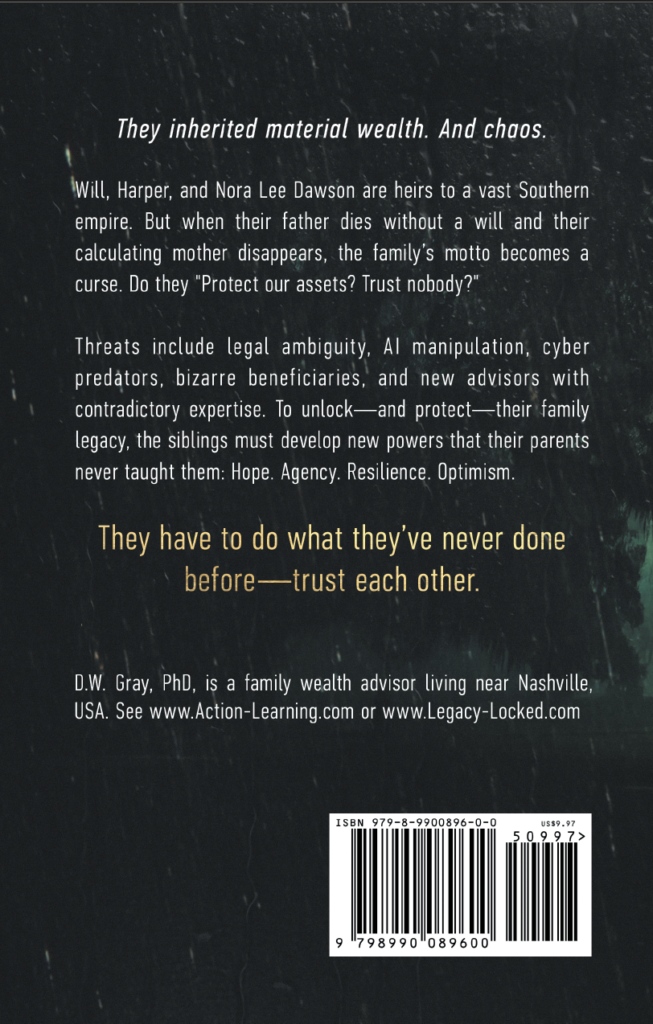
Chapters 1-5 introduce the three siblings, Will, Harper and Nora Lee Dawson, their setting in Nashville, TN, and urgency… The first advisor they hire is an attorney, named Jake Jr.
By 8:45 they met at a parking lot in 12 South. Will walked in silence beside his sisters. Rain pelted the sidewalks. His sisters huddled under a golf umbrella. He adjusted the hood of his raincoat.
He wondered, what the hell are we doing? Why are we meeting Harper’s old flame? Do we really need another lawyer in our lives? He repeated the family mantra like a drumbeat beneath the street noises: Protect our assets.
The building was full of steel and restraint.
A security guard in a tailored blazer confirmed their names and photo IDs. Then nodded them toward a shiny elevator. “First door on the right. Goes directly to the 15th floor. The top floor.”
Will gave a faint smile. At least someone in this town knows how to do their job.
“Do we need a game plan?” he asked.
Harper shrugged. “It’s called a Discovery Meeting. The point is to uncover what we don’t know.”
As the elevator climbed, Will caught their reflections in the brushed steel wall. He bit his tongue.
Three Dawsons. Blurred outlines. Unspoken tensions between them.
No script.
Not much trust.
Only a shared name and shared risks.
And somewhere above them, Jake Madducks Jr. waited.
With his shiny shoes and a view worth fighting for.
The elevator ride to the Madducks Law Firm felt like an ascent into something mythic.
Will stood between his sisters in the mirrored cab. Harper, poised and flawless as always, stared straight ahead. Nora Lee checked her phone, her thumb flicking through notes. Rain glistened on their jackets. The air smelled like wet wool and nerves.
“I think we need a game plan,” Will declared.
Harper didn’t look up. “It’s a discovery meeting. Which means we’ll talk. They’ll listen. And send a bill.”
They reached the top floor. The doors opened to a quiet lobby. All polished concrete and understated wealth. A single executive assistant escorted them to the office suite. She offered drinks but they were denied.
Will muttered, “So far, better than Chamberlain’s place.”
They stepped into an empty room.
Minutes later Jake Madducks Jr. sashayed in like he was walking on stage.
Yellow suitcoat. Green bowtie. White shirt too eager for starch. Shoes polished to a shine so sharp that Will squinted. He moved like someone who had practiced his entrance. Confidence wasn’t the best word. It was all theater.
“Greetings and such,” he bellowed. “Jake Madducks Jr., Counselor-at-Large. Welcome to all y’all.”
Harper hugged him slightly longer than required. Introductions followed.
Jake Jr. ushered them into his corner office. His sanctum. An explosion of leather, locked filing cabinets, polished boardroom table, and a panoramic view of Nashville’s ever-changing skyline. Downtown cranes perched like giants frozen mid-reach.
Will eyed the skyline. “Nice view.”
Jake Jr. winked. “Got to protect the important things.”
Will wondered. Should I let Harper lead this meeting? Should I grill this character? Take the long view? Maybe I should watch the cards fall on the table.
“Well of course I want to take care of all y’all,” Jake Jr. crooned. He used both hands to pull his hair up and over his head as he leaned back. “Please have a seat. Coffee? Sweet tea? No? Then how about if someone shares what brought you into my lovely office today?”
They got to business.
Harper started. “As you may recall, the Dawson family has significant assets in Williamson County. And two other regions. Each of us receives quarterly trust distributions. Those payments increased when we turned thirty. We’re not cash poor. That’s not the problem.”
Jake Jr. nodded. “So, what brings you in?”
“Our father died yesterday. Cardiac arrest. Suddenly.”
Jake Jr.’s eyebrows rose just enough.
“We meet on Friday with Chamberlain Law,” Will added. “Our parents’ firm. Tomorrow.”
“But we’ve never seen the legal documents,” Harper said. “Not the wills. Not the trust terms. Not even confirmation of trust officers.”
Jake Jr. leaned forward. “Do you know the size of those assets?”
Will’s tone was iron. “That’s not relevant here. Or to be shared.”
Jake Jr. raised his palms. “Understood. Let’s reframe: Do you have an asset map?”
Harper shook her head. “Problem #2.”
Jake Jr. clicked his pen. “So: estate documents missing, trust terms unknown, and no clear line of succession. You assume Chamberlain has something legally binding?”
Will said, “We do assume. We hope. But hope is never a strategy.”
Jake Jr. nodded thoughtfully. “That’s common. In wealthy families like yours, parents hold cards close. It’s part legacy. Part asset control. Parents often think of their adult children as little kids.”
Harper declared, “The Transfer on Death law is firm in Tennessee.”
“Yes,” said Jake Jr. “For good reason. Plenty of outsiders have stolen assets from too many of our neighbors. And family members. There are too few antebellum plantations left. A damn shame. Countless celebrities and wealthy people relocate to Tennessee just to avoid capital gains taxes. Too many damn Californians are buying up our lands. Just stating a fact. As you well know, we protect the celebrities in our town, for good reasons.”
Nora Lee added, “I keep a running list… Justin Timberlake and Jessica Biel. Nicole Kidman and Keith Urban. Carrie Underwood and Mike Fisher. Tim McGraw and Faith Hill…”
Will cut her off, “I’m not sure any of that is relevant.”
“Agreed. Then there’s Regan,” Harper said. “Our mother.”
Jake Jr. leaned forward. “And… what’s your concern?”
Harper paused and looked at Will. He asked, “Are we speaking in confidence?”
Jake Jr. declared, “Yes. Definitely. Attorney-client privilege extends to Discovery Sessions like this one. We always practice confidentiality here at Madducks Law. The day any attorney breaches that practice is the day they lose their credibility. And their reputation.”
Will kept wondering. Is reputation more important to you than anything? That yellow suitcoat screams louder than any billboard.
Harper continued. “In confidence, then, problem #3 is our mother, Regan. She keeps her cards close to her chest.”
“That’s a solid habit when playing poker at a table of hostiles. What’s the problem?”
Harper paused again. “Jake Jr., you may recall when we were in our study group you said that I was ruthless, right?”
“I think my words were a bit stronger. Something like, “you’re a ruthless son of a bitch.” He smiled.
“Yes. Well, our mother is the bitch. She bends the rules until she wins. She bluffs high and rarely folds her cards. She has no friends. Our father was her arm candy. He somehow tampered her down when she got too ruthless. And now he’s gone. We haven’t talked about her much, even between ourselves. She is intimidating.”
“She’s… a wild card,” Nora Lee said carefully. “She bends rules until they break.”
“She’s a closer,” Will said flatly. “Our father fronted the charm. She closed the deals.”
Jake Jr’s eyes flicked between them. “So, she’s likely to be named as the executor?”
“Problem #3,” Will said. “We don’t know. Could be her. Could be Chamberlain. Could be someone we’ve never met.”
Jake Jr. brushed his hair back with both hands and leaned back again. “That’s why you’re here.”
Harper nodded. “And because we don’t want to walk into tomorrow’s meeting blind.”
Jake Jr.’s tone shifted slightly. “If I understand, you’re seeking leverage. Legal or strategic. Before seeing documents that may define your future.”
Nora Lee said quietly, “We’re not trying to fight. We’re trying to understand.”
Jake Jr. softened. “Then let’s keep things simple.”
He rose, walked to the whiteboard, and began drawing three boxes.
Scenario One: A will does not exist.
Scenario Two: A will exists, but it’s hidden.
Scenario Three: Someone unexpected holds asset power.
Jake Jr. turned. “Here in Tennessee, if your father died intestate, your mother would receive a third of the estate. Or equal to one share if the split favors her. But if a valid will exists, everything depends on the executor and the trust language.”
“Problem is,” Harper said, “we don’t know which box we’re in. One. Two. Or three.”
“Not yet,” Jake Jr. agreed. “But we can start identifying who might hold that power.”
Will spoke loudly. “We’ve never been told anything. No succession talks. No planning. Just the family mantra: ‘Protect our assets. Trust nobody.’”
Jake Jr. smiled. “Sounds like your parents wanted survivors. Not stewards.”
Will didn’t smile back. “Maybe both.”
They all fell into silence. Nashville shimmered through the glass windows. Bright, ambitious, unfeeling.
Jake Jr. finally said, “Well, you’re here now. That’s a start.”
Nora Lee whispered, “Can you help us?”
Pleading like a young child.
Jake Jr. brushed his hair back with both hands. Twice. Then he stood and faced them as if in a courtroom. “Yes. Yes of course. Tell me more about your mother.”
Will spoke loudly, “Frankly, she’s a reckless, greedy son of a bitch.”
Jake Jr. leaned forward, “Now you’re getting interesting.”
Will started, “Here’s an example. In confidence of course.”
“Of course,” said Jake Jr. “This meeting is not being recorded in any manner.”
Will began, “When we were teenagers our parents accelerated their real estate investments. They acquired properties and grew faster than Hobby Lobby. Another local family enterprise. But they never paid a fair market value. Even for our neighbors. They used the Smucker Firm to undervalue properties, based on fabricated risks. Water contamination. Toxic chemicals. Drainage. Undeclared easements. Mineral rights. Fake cemeteries. The details varied but the outcome was always the same.”
“It wasn’t always that drastic,” said Nora Lee. “They weren’t criminals or anything.”
“They skirted the laws,” said Harper. “That’s one reason why they never talked about business with us.”
“And one reason why Harper and I have never been involved. Somehow cut-throat real estate deals were not for young women to discuss,” said Nora Lee.
“Even though our mother, Regan, had a long history of being ruthless. You know about fact patterns. When there’s smoke everywhere, someone’s hiding a match,” said Harper.
Jake Jr. smiled again. “I like you three.”
“Let me give you some more context,” said Will. “When the Smucker Firm said that a property was worth 50% less than other appraisals, the sellers got scared. Every time. They ended up selling for 40% of their asking price. The sellers didn’t know any better. Most local sellers were farmers who inherited the land. Some were old church properties with deacons who were well intentioned but clueless. The sellers were astounded by the growth in Williamson County.”
“But they were told that if they didn’t accept the Dawson offer, then the Smucker Firm would make those risks public. Then the sellers would never see a better offer. Not quite extortion. Not quite illegal. And of course there were never any records of those private talks. But the fact pattern got back to me. Frankly, the three of us have never discussed how our parents acquired their assets.”
“Mostly because two of us, as girls or women, were shut out of the damned family business!” said Harper.
“Also, because I got scared,” said Nora Lee. “We were told to share our opinions. But if I did, I got shut down. So, I retreated. Part of me still doesn’t want to know how they gained so much wealth in only 30-40 years.”
“I can tell you that. I studied them,” said Will. “When needed, our mother was the closer. But most of the time she leveraged the Smucker Firm. They fabricated risks used as leverage to buy assets at reduced rates.”
Jake Jr. leaned forward. “Who owns the Smucker Firm?”
Will groaned. “I don’t know. The CEO is an empty suit. I’ve asked Chamberlain but the old bastard never answers me directly. Our father was the more friendly face in business. And our mother was the greedy son of a bitch. Behind the curtain unless needed.”
“Take it easy, Will,” said Nora Lee.
“Why? We haven’t talked about them. Maybe today is the day to do so! We’re all adults. This meeting is in confidence. Right?”
“Absolutely,” said Jake Jr. “And you three have a fascinating story. Do you have any examples with evidentiary material, like deeds or email threads?”
“Yes, of course,” said Will. “That has been my role for the past 10 years. I manage properties after they acquired them. Here’s an example that was described in the Williamson Herald. Plenty of local dispute from bloggers. The bottom line up front is that our mother always gets more reckless when the stakes get higher.”
“Easy bro,” Nora Lee spoke quietly.
“I think he needs to know some details! Context. We need to bring some of these stories to the surface,” said Will. “Hear me out then you can decide.”
“Discovery. That’s why we’re here,” said Harper.
Will continued. “One of our neighbors owned 520 acres of rolling farmland, just off Cool Spring Boulevard. Before the mall was created, we used to ride dirt bikes there. Bicycles. Not motorcycles. It was one of the largest parcels in Williamson County. And it was one of the only times when they had to use a personal line of credit from the bank. She wrote the demand letter and terms. His name was used. Not hers.”
“Yikes,” said Jake Jr.
“Exactly. He was furious with her! And her private accounts were transferred to First Citizens Bank. To establish some distance from his risks. She kept spending. Like any addicted gambler. He could express frustration. Or his fury. But he could never manage her.”
Harper spoke up, “So, now we are like those sellers. We think we have assets. But we don’t know their value. And we can’t access the papers. None of us want to be her next target. We want to know our options.”
Nora Lee whispered for the second time, “So, can you help us?”
Still pleading.
Jake Jr. ran both hands through his hair. Three times. That gesture bought him time.
“Well,” he said, in that stretched Southern drawl, “yes of course I can help y’all. Be glad to. What a fascinating family you have.”
He paused like an actor waiting for the next cue. Then he walked to the head of the boardroom desk.
“We’ll start with the basics. Here in Tennessee, when someone dies without a valid will, that’s called dying intestate. Our laws dictate asset distribution. In your case…”
“Spouse and children,” Harper interrupted. “We know. The closest surviving relatives.”
Jake didn’t flinch. “Right. But legal structures don’t always match the deceased’s intentions. That’s why a valid will matters. Any documentation? Estate plan? Drafts?”
“No.” Will’s voice was hard. “That’s problem number one. Remember?”
Shit. Did you not hear us the first time? Another empty suit. A yellow suit coat. We’re wasting our time here…
Jake opened his arms like a preacher mid-sermon. “So! No copy of a will means we begin with assumptions. If your father left no valid document- and I’m not saying that’s certain- then the spouse receives either a third or an equal share with children. Whichever is greater.”
“Because there are three of you,” he continued, “that could mean your mother gets a quarter. The rest of the estate gets split evenly between you kids.”
“We just don’t know,” Harper snapped. “So, we assume the worst. That’s why we’re here.”
“I’m confused,” Nora Lee said. “You said ‘whichever is greater.’ So, is it a third, or a quarter?”
Jake gave a politician’s shrug. “Can’t say yet. Again, that’s assuming there’s not a will. A big if. Box number one.”
Nora Lee leaned in. “What about Emily? His first wife?”
“Divorced and remarried? Then no. She’s not in his intestate line, legally speaking.”
Will’s thoughts moved faster than the shifting wind in the room.
At least Jake didn’t say ‘It depends.’ But what is Nora Lee fishing for?
“Has she reached out to you?” Will asked her. “Emily texted me yesterday. I didn’t reply.”
Harper rolled her eyes. “She’s not relevant. Lonely. Maybe a gold digger. Keeps Dawson as her last name like some sad identity badge. Lives alone with her cats.”
Nora Lee paused then spoke quietly. “She never remarried. No kids. That’s true. But she wants to stay connected.”
Harper stared. “Something you want to share, sis?”
“Maybe. Maybe not. I like her. We talk. She cares about us. About all of us.”
Will stared at the floor.
So, Emily’s been meeting with our baby sister. Gathering intel. Why? Is she angling for something? Payments? Position? Did Emily and our father stay close after their divorce?
Harper pulled them back. “Let’s move on.”
Jake Jr. shifted his feet- ready for a second boxing round. “Right. Second scenario: there may be legal documents, but none of you have access. Box number two. That limits your power. Without a will, you can’t execute your father’s intentions, whatever they were.”
Harper’s fists clenched. “So, we’re screwed? Damn it all.”
Jake Jr. kept calm. “You believe a valid will exists. But you don’t have a copy. So, we begin where the law begins. With assumptions. In the absence of a will, the state steps in. If there’s a surviving spouse and three children, like all y’all, then you each get a quarter.”
“Unless,” Harper said, “there’s a will that says something else.”
Jake Jr. nodded, lips pressed tight. “Exactly. And we don’t know that yet. So, worst-case scenario planning makes sense.”
“I still don’t understand,” Nora Lee said. “You said the spouse gets a third. Now it’s a quarter?”
Jake Jr. raised a finger. “It’s whichever is greater: a third, or an equal share with the kids. In your case, four potential heirs, so one-fourth to each. That’s if there’s no will. These are fictional examples.”
Harper leaned forward. “And if there is a will?”
“Then everything depends on what it says. The details. Executor named. Beneficiaries listed. Powers granted. If it even exists.”
Harper nodded, her voice sharp. “Which brings us back here.”
Will scratched his jaw. “And what about his first wife? Emily?”
“She’s not part of this,” Harper said quickly. “Divorced. No children. No claims.”
Nora Lee shifted in her chair. “That’s not entirely true. She never remarried. Kept the Dawson name. And she reaches out.”
Will watched Harper narrow her eyes. “Is there something we should know?”
Nora Lee hesitated. “We have tea. Every few months. She cares about the family reputation. She asks questions.”
Harper snorted. “Sounds like intel gathering.”
“She’s lonely,” Nora Lee said. “That’s not a crime.”
Will didn’t speak. But the thoughts were already formed.
Nora Lee’s too quiet. That always means something. I wonder if someone else has a copy of the estate documents. I wonder if Nora Lee has taken a copy from Emily.
Jake Jr. stepped forward again, his voice quickening.
“Now. Back to the second scenario: a legal will exists, but you don’t have access. That seems to be your reality.”
Harper’s voice cut clean. “So, what can we do?”
Jake Jr. didn’t sugarcoat it. “Very little. If you can’t produce the document, you can’t assert its contents. Hearsay doesn’t hold in probate court. No matter how many times your father may have said something over a bourbon.”
“And what if he said he wanted to exclude someone?” Will asked.
“Still hearsay,” Jake Jr. replied. “Intentions are not legal instructions.”
Harper swore under her breath. “So, now what? We’re screwed?”
Jake Jr. didn’t answer. He just kept moving. Literally pacing like a man boxing invisible shadows.
“Best case? Chamberlain Law has a clean will, sealed, signed, dated. Written in sound mind and body. With witnesses. Names an executor. Lists the assets. Designates power of distribution. Those legal responsibilities are clearly defined.”
He turned to the siblings. “Did your father name any of you executor?”
They exchanged glances. Pauses. Each shook their head sideways.
Will thought of the mantra. Trust nobody. That fact sucks. He didn’t name any of us. If our father didn’t trust me to manage the estate, what else didn’t he trust me with?
Jake Jr. punched forward. “If none of you are named, the next likely executor is your mother.”
Will exhaled through his nose. “Of course. Shit.”
“She’s experienced,” Jake Jr. added. “Business-savvy. Ruthless, maybe, but probably capable. Most surviving spouses are named as the executor. Even if that person is struggling with grief. That’s why survivors are targeted by wealth advisors and insurance salesmen. Damned vultures.”
Will muttered, “She’s capable of doing whatever the hell she wants.”
Jake Jr. let that sit.
Then he said, “There’s a third possibility. Box three. If your father named someone outside the family. A friend. A firm. To avoid infighting. Or legal disputes. Or manage philanthropy. It happens.”
Harper’s voice was cold and slow. “Topher Chamberlain, maybe?”
Jake Jr. didn’t respond. He couldn’t.
Will clenched his fists beneath the table.
“There’s also a fourth possibility,” Jake offered, warming again. “Extended family. Uncle, aunt, cousin. Someone who knows the internal dynamics but isn’t at the emotional epicenter. Someone who can manage a family foundation. That can be ideal in high-net worth estates.”
“We don’t have extended family like that,” Will said. “Thanksgiving is a very small event.”
Jake Jr. gave a half-shrug. “Still worth asking.”
Harper said, “Huh? What about a family foundation? We’ve never discussed one.”
Nora Lee broke her silence.
“There is a family foundation,” she said softly. “I’ve been running it for six years.”
For the remaining chapters, go to www.Action-Learning.com
EPILOGUE
One month later.
A press release hit the wires:
The Dawson Family Foundation announces a new charter: focused on financial education, small business equity, and trauma recovery in Southern communities.
The board now includes all three Dawson siblings, with rotating leadership every two years. Plus, four independent board members with non-competing expertise.
A final clause stated, “We share the belief that leadership must evolve. Or it ceases to be effective.”
Back in Richard’s former office, two granite blocks sat on the Reliance oak desk.
The family motto had changed.
Will had engraved a new granite block with a brass plate and golden letters.
Protect our purpose. Trust each other.
Discussion Questions for your Book Club or family meeting:
1. About your family
When Richard Dawson, the family’s powerful patriarch dies without an estate plan, the heirs face a cascade of secrets, succession struggles, and long-buried grievances. For unexplained reasons, their mother Regan is absent. Loyalty is fragile. Memory is unreliable. Blood may not be thicker than paper… So, how is this plot similar or different from your family of origin? Your current family? Your desired family?
2. “Protect Our Assets. Trust Nobody”
These phrases repeat throughout the story like a heartbeat. How do they shape each characters’ behavior? Their relationships? Is it a legacy or a curse or something else…?
3. Family Identity and Roles
Each sibling (Will, Harper, Nora Lee) reacts differently to Richard’s death and Regan’s absence. They crave different things- stability, control, or peace. How are their roles shaped by birth order, gender, personality, or blind spots? What is unrealistic about their behavior? What characters do you relate to most, and why?
4. Inheritance and Power
The notion that adult siblings have no awareness of a $120 million inheritance is unrealistic. And not impossible. Would the story be less impactful of the inheritance was $1million or $10 million? What does inheritance mean in this story- money, control, memory, responsibility, or…? How do the siblings navigate entitlement vs. purpose? Dr. Jenn says, “Time is Right.” Do you agree?
5. Regret and Silence
Many characters- especially Will and Nora Lee- carry unspoken regrets. This story is only one week in their lives. What moments reveal their regrets and fears most clearly? Why do these silences persist?
6. Southern Setting and Expectations
How does the Nashville backdrop influence expectations for behavior, gender roles, and power dynamics in the family? How do the scenes in Monteagle contrast to the scenes at Hickory Ridge? How do the indoor and outdoor scenes contrast? How do music, food, guns, preppers, and religion influence these characters?
7. Emily and Regan
Compare the characters of Emily and Regan, two matriarchs with different legacies. And very different family roles. Matriarchs often lead family succession plans and wealth distribution. What do their choices say about survival, visibility, and emotional costs in this family system?
8. Real Psychology, Real Stakes
The author is a behavioral psychologist. (Some useful definitions are provided in the next pages for your reference.) Where do you see real-life psychology reflected in these characters’ decisions? Do the siblings develop psychological capital? How does their advisor triad (Dr. Jenn- process, Colton- wealth, Jake Jr.- legal) accelerate their behavior changes?
9. Bonus Question
What would you do if you discovered your family had no succession plan- but millions in assets and secret enemies within?
Some Useful Definitions with examples:
Active listening = a communication practice that requires sharing information until the speaker feels validated. Example: When Nora Lee asked, “Did he ever say he was proud of us?” and Will didn’t rush to answer. That was active listening. The kind that leaves space for reflection or truth.
Active owners = people with voting shares of an asset, including risks or rewards
Advisory board = a group of trusted advisors who provide advice to owners
Agency = an individual’s capacity to state important thoughts or feelings. Examples: Harper finally called a new legal team at Madducks Law. That wasn’t rebellion. It was agency, and perhaps long overdue. Will texted Dr. Jenn, and then Colton, and added them to the advisor team. Nora Lee reached out to Hannah, ventured beyond D-House, and brought a surprise guest musician to the Hickory Ridge dinner. Agency describes each character’s development.
Aspirational goal = a big, unattainable vision of a better future
Aspirational behavior = an exceptional, remarkable behavior from people who exceed expectations
Behavioral script = a communication model used to state feelings, undesired behavior, and desirable behavior
Business system = a description of how people fit into a unique system and deliver a valuable product or service
Complete communication wheel = a script with five parts: data, emotion, judgment, want, will, plus opening and closing questions
Conflict = a response to different data or perspectives. One conflict model describes the interactions between task, relationship and process. Example: The siblings have more relationship conflict than task conflict. They don’t disagree about money, because they don’t know much about money. But when Harper needed to fight for her son, Mason, all the characters quickly responded to that conflict!
Conflict management = the process of responding to others with degrees of assertiveness or cooperation
Constructive feedback =positive statements that focus on desired, prosocial behaviors
Culture = a model used to describe organizations, based on underlying assumptions, stated values and artifacts
Data = facts that are quantitative (using numbers) or qualitative (using images or words). Example: The distribution decisions are reversed to make some points about data. These siblings do not approve their parent’s distributions in G&G. They do approve of the distributions to themselves, the family foundation, and the well-being trusts. Those are each data points, facts.
Destructive feedback = negative statements that diminish others, and should be avoided.
Distributions = financial or equity assets that are managed and transferred over time. Examples: The Dawson siblings have had distributions for years. As Harper says, “We are not cash poor.” Their frustrations about distributions include the mysterious terms of the trust officers, location of the estate documents, and scope. They learn to trust Chamberlain. But they don’t have a clue about stewardship or future distributions.
Empathy = the capacity to understand another person’s perspective
External audit = an assessment process led by expert financial, legal or talent consultants
Family system = a description of how related people support their shared values and beliefs
Family capital = a dynamic social construct of shared values lived intentionally. Example: When Dr. Jenn introduces this term, the siblings realize that they have family capital. That it can change. That they need to be intentional together, to protect their inheritance and legacy.
Feedback =what others say or do that shapes personal learning
Fiduciary board = a group of expert advisors with financial responsibility for an asset
Fixed mindset = a belief opposing new ideas or behavior
Flow optimization = a behavioral model describing the balance between challenge and skill
Formal learning = the process of using content to demonstrate mastery of a skill
G2 = second generation family members, G3 = third generation, and so on…
Governance = a shared understanding for decision making, usually with written guidelines. Examples: The Dawsons had plenty of material wealth. But no governance. Like many Next Gen beneficiaries, they were anxious to discover the trust terms from Chamberlain. Then they quickly hired a triad of expert advisors- Dr. Jenn for process, Colton for finances, Jake Jr. for legal concerns. Those advisors may accelerate good governance, and smart decisions, for the siblings. Even for scary beneficiaries like the G&G, LLC.
Gratitude = the behavior of expressing appreciation for the good things in life
Growth mindset = a belief of openness to new ideas or behavior
Hope = the capacity to believe in the will and the way toward a desired outcome. Example: When Harper visits the shooting gallery, Big Mamas, she vents her anger by shooting at images of her husband, Jordan. Then she expresses hope for the meeting with Chamberlain.
Individual system = a description of how people integrate skills and talents into a uniquely meaningful life
Informal learning = the process of using available resources to develop a skill or competency
Innovation = a new idea applied using experiments
Leaders = people who influence the behavior of followers toward a positive vision. The core skill of effective leaders is public optimism. Examples: Will asserts himself inconsistently and needs to develop his leadership skills. Nora Lee and Harper need to develop their influence with their followers, Hannah and Jake Jr.
Learning journal = an individual or team reference documentwith key questions, definitions, and resources
Learning system = a description of how people adapt to new informationand fit into a unique family or business
Loss aversion = a cognitive bias that influences people to avoid any real or perceived loss
Managers = people who maximize the productivity of others. The core skill of effective managers is coaching.
Negative feedback =statements that describe undesired behaviors
Operational behaviors = the required behaviors from people who deliver a product or service
Optimism = the ability of individuals or teams to believe in a better future. Examples: When Will, Grady and Colton describe the preppers and G&G, everyone expresses fear. Then optimism. All three siblings call meetings and take optimistic actions.
Ownership system = a description of how owners assess and manage the long-term assets of a family or business
Passive owners = people with an interest in an asset but do not have voting shares
Perception of fairness = the shared belief that a fair policy serves the long-term best interests of the owners and rewards desired behaviors
Positive feedback = positive statements that reinforce desired behaviors
Positive regard = the deepest human yearning based on safety, connections and dignity
Positivity spirals = behavior thatencourages people to broaden their options and build solutions
Primogeniture = an ownership practice of providing harmony and continuity to the eldest son
Psychological capital (Psy Cap) = a personal or team development model which measures Hope, Efficacy, Resilience and Optimism. For convenience in this fictional novel the word “agency” was substituted for the academic word “efficacy.” Example: After Dr. Jenn introduces the concept, the siblings use those four words more frequently. They practice these four new skills, when using AI, learning about G&G, or protecting Mason.
Relationship conflict = a description of the interpersonal interactions with others, that often perpetuate negative behaviors
Resilience = the ability of individuals or groups to get through difficult times or circumstances. Example: When Nora Lee has another panic attack, and four people quickly support her.
Risk avoidance = the willingness to avoid one behavior
Risk tolerance = the willingness to do one behavior instead of losing another related behavior
Self-awareness = a personal narrative from assessments or feedback that should be reliable and valid
Self-deception = an inaccurate personal narrative based on low self-awareness or inaccurate feedback from others
Shareholder dynamics = the infinitely complex dynamic interactions between shareholders, each with a vested interest in real or potential assets
Social capital = a measure of the tangible and intangible relationships between people
Task conflict = a description of the information necessary to function with others
Triangulation = the communication practice of sharing information indirectly when it should be shared directly. Example: Every time one of the siblings asked, “Have you talked with our mother?” instead of finding Regan. Many families avoid direct communication. Just like the Dawson’s, triangulation perpetuates chaos.
Value-based consulting = a process designed to structure key relationships, results and personal behaviors
To discuss your Family Wealth Advisory concerns (e.g., succession planning, asset transfer, legacy, governance, philanthropy, communication…) or 360 leadership assessment consulting services, visit www.Action-Learning.com ASAP.
Nothing is more urgent.
Recent Comments